Torchlight Walks on Summerland Beach in the 1920s
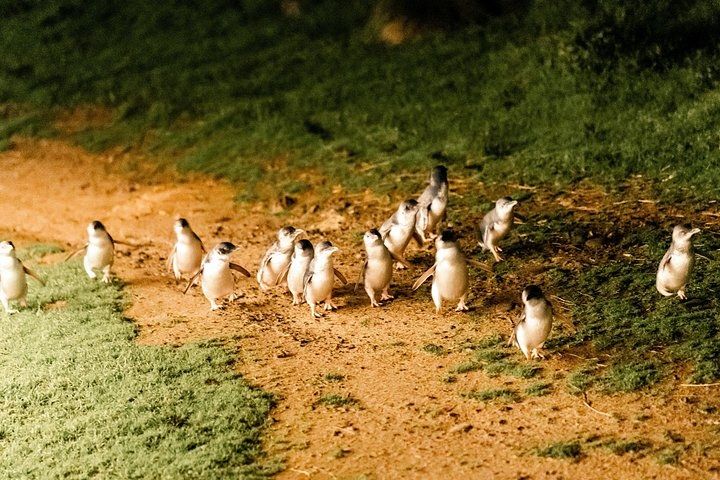
Commercial penguin viewing at Summerland Beach dates to the 1920s, when local men began walking small groups of tourists down to the sand by torchlight to watch the little penguins come ashore after sunset. The birds had been landing there for far longer, in rafts that gather offshore and wait for dusk before crossing the open beach. Access was the limiting factor until late 1927, when the first road to the colony was built. The same year the Summerland Estate was subdivided into 776 lots on the peninsula above the burrows, setting up the conflict between housing and habitat that took the rest of the century to resolve.
Protection arrived slowly. The Department of Fisheries and Wildlife declared the first government reserve over the colony in 1955, by which time the subdivision was filling with holiday houses, and 190 homes were eventually built. Systematic counting of the nightly crossing began in 1968, with guides tallying every bird that walked up the beach, a method still in use. Nine of the island's ten original little penguin colonies disappeared over the same period, leaving the Summerland Peninsula as the last one standing. In 1985 the Penguin Protection Plan set out the buyback of the estate, house by house, so the burrow ground behind the beach could be returned to the birds.
What Happens on the Beach, and Why
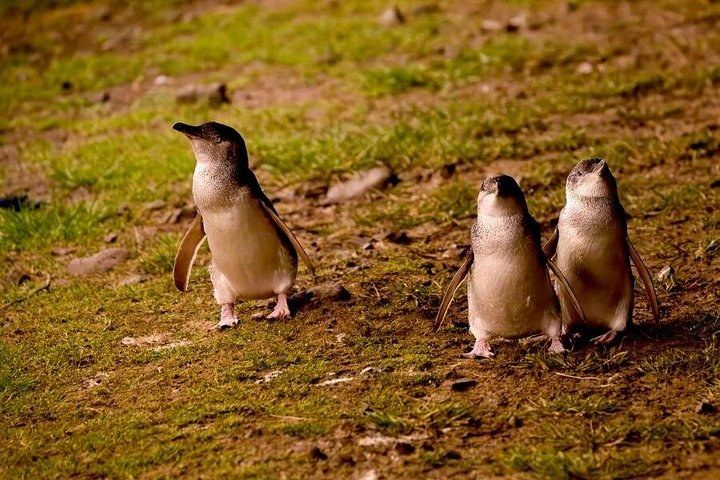
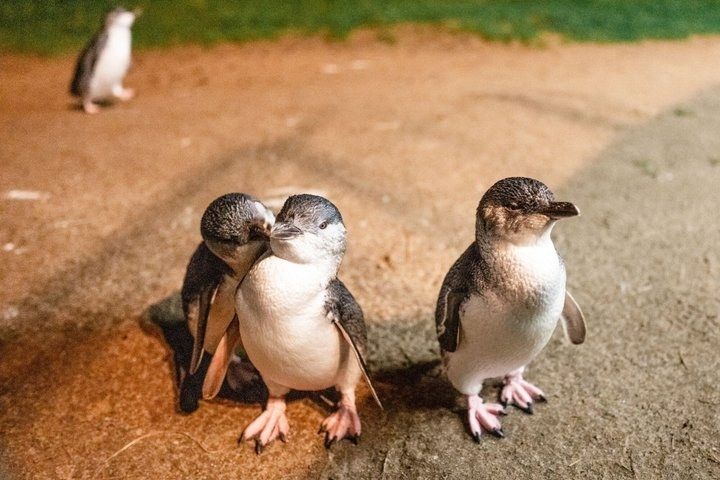
Little penguins are the smallest penguin in the world, just under a kilogram and little taller than a bowling pin. They spend about 80 per cent of their lives at sea, feeding on small schooling fish and squid: young barracouta, anchovies, red cod, warehou and pilchards, roughly 250 g a day. A single bird dives between 1,300 and 2,000 times a day, usually to 10 to 30 metres, cruising at 2 to 4 km/h with bursts recorded at 12 km/h. Tracking during the breeding season shows most Phillip Island birds feed within 50 kilometres of the colony, and adults can stay out for more than four weeks between visits ashore.
Penguins cross in waves because they gather offshore in rafts and wait for darkness before committing to the open sand. Pacific gulls and sea eagles hunt them, so numbers and low light are the defence. That behaviour is also why cameras, camcorders and phone cameras may not be used after sunset at the Penguin Parade: little penguins have sensitive eyes, and sudden or unusual light can frighten and disorientate them. Visitors cannot photograph the crossing itself. Bring a camera for the daylight hour before the birds land, which is when swamp wallabies, Eastern barred bandicoots, Cape Barren geese and short-tailed shearwaters show up along the boardwalks.
Breeding at the colony usually runs from August to February; both parents incubate, eggs hatch after about 35 days, and chicks head to sea for the first time at about eight weeks old. From the second half of February, with the earliest birds starting in mid to late January, adults come ashore for the catastrophic moult, standing on land for a median of 17.5 to 18 days and fasting through it, losing close to half their body mass. Average nightly counts across 2021 ran from about 700 birds in July to about 2,300 in November, and peak-period crossings have reached between about 3,000 and 5,000.
Key Dates and Numbers Behind the Penguin Parade
1927
First access road to the colony built, in late 1927
1955
First government reserve declared over the penguin colony
1996
Phillip Island Nature Parks established as an organisation
2017
Phillip Island declared fox-free after a 20-year program
25 July 2019
Current A$58.2 million visitor centre opened
40,000
Estimated little penguins today, up from about 12,000 in the mid-1980s
From Housing Estate to Conservation Project
Phillip Island Nature Parks was created as an organisation in 1996, bringing together land previously managed by the Shire and the Department of Conservation and Environment. It is self-funded, owned by the Victorian State Government, and covers more than 1,805 hectares across several separate areas of the island. Visitor revenue goes back into research, environment and education programs, which is why the Penguin Parade reads more like a field station with a grandstand than an attraction built purely for entertainment. Nightly counts feed into long-term population monitoring, so the same figures that tell a visitor how busy the beach was also tell scientists how the colony is tracking.
Buying back Summerland Estate took 25 years. Begun under the 1985 plan, it was completed in 2010 and the remaining houses were removed, after which the Victorian Government funded a three-year, A$3.4 million habitat restoration program on the cleared land: revegetation, weed removal, artificial nest boxes, and control of foxes, feral cats and rabbits. Fox-free status followed in 2017, after a 20-year eradication effort that took the main land predator out of the equation. Monitoring recorded about 12,000 little penguins in the mid-1980s against an estimated 40,000 today, and the Summerland Peninsula colony is one of the largest of the species.
Nature Parks opened the current visitor centre on 25 July 2019 at a cost of A$58.2 million, with A$48.2 million from the Victorian Government's Regional Tourism Infrastructure Fund. Its position mattered as much as its facilities: demolishing the old centre and coach park restored more than six hectares of penguin habitat, room for an estimated 1,400 additional breeding penguins. More than 700,000 people now come each year, with the Victorian Government projecting 840,000 annually by 2030. Inside, the Shearwater Restaurant runs from midday to 9pm and Chicks Café opens at 4pm. Burrow and boardwalk upgrade works are under way at the site, and the nightly arrival continues unaffected.
Visiting the Penguin Parade Today
This is an evening event. Little penguins come ashore at Summerland Beach at sunset every single night of the year, so there is no closed season and no night without a crossing, and the weather never cancels it. The visitor centre opens at midday, 2pm on Christmas Day, and the whole site works as an afternoon-and-evening visit. Start time tracks sunset and swings by roughly two hours across the year: Nature Parks describes the centre filling from about 4pm in winter and about 6pm in summer, and publishes a Penguin Arrival Calendar with estimated times. Look up your own date rather than trusting a seasonal range, and check it again on the day.
Plan to be in your seat before dark. General Viewing, Penguins Plus and Penguins Premium holders are asked to arrive at least an hour before the estimated arrival time, Underground Viewing holders 30 minutes before. Bring warm layers, a raincoat if rain looks likely and a rug for the grandstand seats; the stands face an exposed southern beach and the event runs in the rain. The site is cashless, with contactless payment only. Getting back is the part people underestimate: the Penguin Parade sits at 1019 Ventnor Rd, Summerlands, about 90 minutes from Melbourne plus 20 minutes from the San Remo bridge, and no buses return to Melbourne after the crossing.