In shortLittle penguins are the world's smallest penguin, just under one kilogram and little taller than a bowling pin. They eat about 250 g of small fish and squid a day, make 1,300 to 2,000 dives to get it, dig their own nest burrows and spend roughly 80 per cent of their lives at sea. Rafting offshore and holding off until dusk before they cross the sand is how a bird that small handles predators.
just under 1 kgAdult body weight
1,300-2,000Dives per day
250 gFish eaten daily
about 40,000Breeding birds on the peninsula
What the colony numbers mean on the night you visit
About 40,000 breeding little penguins are estimated to live on the Summerland Peninsula, one of the largest colonies of the species, and monitoring tracks a rise from roughly 12,000 birds in the mid-1980s. None of that is the number that crosses the sand on a given night. Guides count every bird that lands. Across 2021 the nightly average ran from around 700 in July to around 2,300 in November, peak-period nights carried roughly 3,000 to 5,000, and two record counts reached 5,219 and then 5,440.
The gap between colony size and nightly count comes out of the biology. About 80 per cent of a little penguin's life happens in the water, and one foraging trip through Bass Strait and Port Phillip Bay can keep an adult away from land for more than four weeks at a time. The birds you watch land are the ones with a burrow, an egg or a chick waiting for them.
- World's smallest penguin, just under one kilogram, little taller than a bowling pin
- Crosses Summerland Beach at sunset on every day of the year, whatever the weather
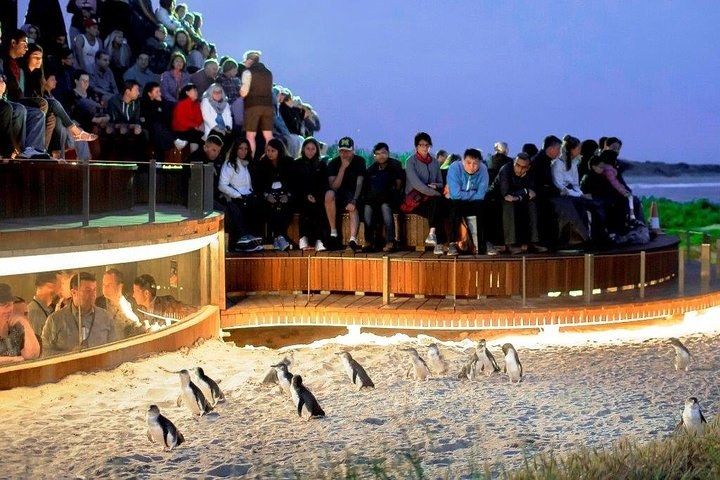
- Lands in waves, because the birds gather offshore in groups called rafts
- Nests in a burrow that the male and the female dig together
- Returns to land only to breed and to moult
Little penguin size and weight
Phillip Island Nature Parks describes the little penguin as weighing just under one kilogram and standing little taller than a bowling pin. Carry that figure down to the viewing stands. The bird is smaller than many visitors expect and easy to miss against the sand. Look low, near the water line, and watch for movement instead of shape.
No height in centimetres appears on the Nature Parks pages consulted for this site, and third-party sources disagree, so treat any precise number you read elsewhere with caution. The weight tells you more. A bird carrying under a kilogram cannot afford a wasted trip to sea, which is why roughly 250 g of fish a day, about a quarter of its own body weight, matters so much.
Older Australian usage calls the same bird a fairy penguin, and you will still hear that name around the island. Nature Parks uses little penguin across its research and visitor material, and so does this site.
Small-group day trip from Melbourne
Reaching the beach means about two hours each way, with the return leg after dark. This 12-hour small-group day from Melbourne covers the driving and includes general entry to the Penguin Parade and to Moonlit Sanctuary, from A$169, rated 4.8 (163 reviews).
★ 4.8/5 · 163 reviews
Burrows on the Summerland Peninsula
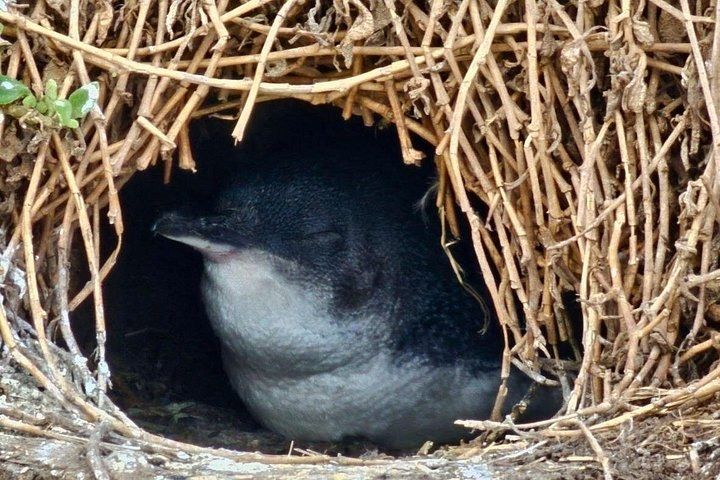
Both the male and the female dig the nest burrow and line it, using sharp claws to cut into soft sand or soil. The habitat behind the beach therefore counts as much as the beach itself, which is what made a housing subdivision on top of it such a problem: the Summerland Estate was cut into 776 lots in 1927 and built up with 190 homes on penguin ground. The buyback began under the 1985 Penguin Protection Plan, finished in 2010, and the last houses came down.
Habitat work on the peninsula now runs to revegetation, weed removal, artificial nest boxes and the control of feral cats and rabbits. The island was declared fox-free in 2017, after a twenty-year eradication program that removed the main land predator. Demolishing the old visitor centre and its coach park gave back more than six hectares of habitat, with room for an estimated 1,400 additional breeding penguins. The conservation page on this site carries the longer version.
Some of that burrow work is live right now: the Penguin Parade has upgrades in progress on burrows and boardwalks. The nightly arrival goes ahead as usual, though it is worth knowing about before you plan how you will move around the site.
The breeding and moult calendar
Breeding at the Phillip Island colony usually runs from August to February, and those are the months with the most birds crossing, because a parent with a chick in a burrow has to come back and feed it. Both adults share incubation and the eggs hatch after about 35 days. Chicks make their first trip to sea at around eight weeks old.
Breeding gives way to the moult in the second half of February. Each adult goes through a catastrophic moult, replacing all its feathers at once, which means staying ashore and fasting. Phillip Island research measured a median of 17.5 to 18 days on land, with a range of 12 to 25 days, over which a bird loses close to half its body mass. The earliest individuals start in mid to late January.
| Stage | Timing | What it means on the beach |
|---|
| Breeding season | August to February | Most crossings, with adults returning to feed chicks |
|---|
| Incubation | About 35 days, shared by both parents | Birds swapping places at the burrow |
|---|
| Chicks to sea | At about eight weeks old | End of the chick-rearing phase |
|---|
| Annual moult | Usually from the second half of February | Median 17.5 to 18 days ashore fasting, range 12 to 25 days |
|---|
Diet, dives and how far they travel
A little penguin hunts small schooling fish and squid: young barracouta, anchovies, red cod, warehou and pilchards. It can eat about a quarter of its own body weight in a day, roughly 250 g, and it makes between 1,300 and 2,000 dives to get it, mostly to depths of 10 to 30 metres. Cruising speed is 2 to 4 km/h, with 12 km/h recorded in a sprint.
Tracking puts most Phillip Island birds within 50 kilometres of the colony during the breeding season, close enough for a parent to be home the same evening. Outside breeding they range further and stay out longer, and the beach is quieter for it.
Why they come ashore after dark and why cameras stay off
Penguins gather offshore in rafts before coming in, then wait for dusk before crossing the open sand. Pacific gulls and sea eagles hunt little penguins from the air, and a single bird on bare beach in daylight is an easy target, so the birds use numbers and darkness together. That is why the arrival comes in waves rather than a steady trickle, and why none of it happens before sunset.
That reliance on darkness is also the reason no camera, camcorder or phone camera may be switched on after sunset at the Penguin Parade. Little penguins have sensitive eyes and sudden or unusual light can frighten and disorientate them. The rule is enforced, and visitors cannot photograph the crossing itself. The daylight hour before sunset is the one window you can use a camera at all, and the boardwalks in that hour reliably turn up swamp wallabies, Eastern barred bandicoots, Cape Barren geese and short-tailed shearwaters.
Because the birds come in on dusk rather than a clock, the start time swings by roughly two hours over the course of the year. In Nature Parks' own description the visitor centre starts filling from about 4pm in winter and about 6pm in summer, and estimated times for individual dates sit in its Penguin Arrival Calendar. Check your own date on the arrival times page of this site before you fix anything else, and plan to be there well before dark.
Questions people ask
How long do little penguins live?
No lifespan figure from Phillip Island Nature Parks could be verified for this page, and third-party numbers vary, so none is published here. What the Nature Parks research pages do confirm is that the Summerland Peninsula colony has grown from about 12,000 birds in the mid-1980s to an estimated 40,000 breeding little penguins today.
Are fairy penguins and little penguins the same bird?
Yes. Fairy penguin is an older Australian name for the same species you watch at Summerland Beach. Phillip Island Nature Parks uses little penguin throughout its research, education and visitor material.
Can I see the penguins during the day instead?
No. Little penguins come ashore at sunset and spend the daylight hours at sea, and adults can stay out for more than four weeks at a stretch. The Penguin Parade Visitor Centre opens at midday, 2pm on Christmas Day, but the crossing itself happens only after dark.
Is it worth going during the February moult?
The crossing happens every night of the year, so you will see penguins. Fewer birds cross while individuals sit ashore moulting and fasting for a median of 17.5 to 18 days, and February at the Rhyll station is the warmest and driest month of the year, with a mean maximum of 24.4°C and 37.0 mm of rain, which makes for a more comfortable evening on an open stand.
Do penguins come ashore in bad weather?
Yes. Rain means nothing to a bird that has just spent days in the sea, so the birds land and the parade is never cancelled for weather. You are the one who notices it: the viewing stands are open to the southern coast, and Nature Parks advises warm clothes, a raincoat if rain looks likely and a rug for the seats. At Rhyll the July mean maximum is 13.4°C and the mean minimum 8.2°C.
Read also