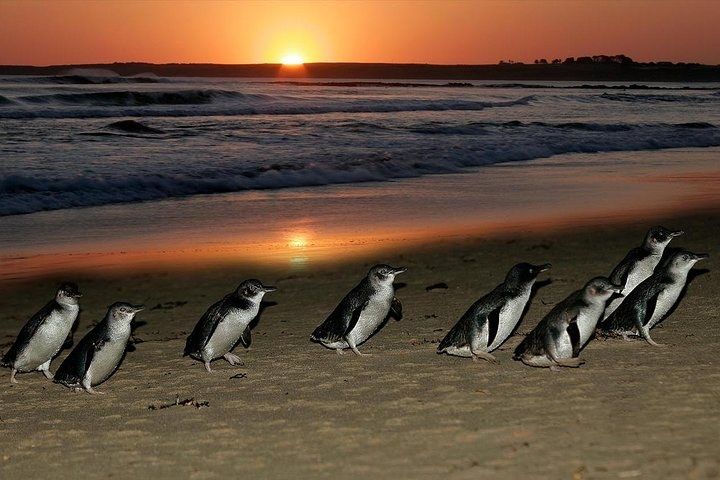
In shortLittle penguins come ashore on the Summerland Peninsula, at Phillip Island's western end, because the soft ground behind Summerland Beach is diggable enough for nest burrows and the Bass Strait fishing grounds lie within about 50 kilometres of it. They only cross the open sand after sunset, when darkness and sheer numbers cover them from Pacific gulls and sea eagles.
about 40,000breeding little penguins here
9 of 10island colonies now gone
1955first reserve declared
2010housing buyback completed
The ground, the water and why this stretch of coast works
The ground decides it. Little penguins dig their own burrows, both adults working the material with sharp claws, and the Summerland Peninsula behind 1019 Ventnor Rd, Summerlands, at the island's western end, is sand and soil soft enough for a bird under a kilogram to shift with its feet.
Position counts as much as the substrate. Tracking by Nature Parks scientists shows most Phillip Island birds feeding within 50 kilometres of the colony through the breeding season, working Bass Strait and Port Phillip Bay, and adults sometimes stay out for more than four weeks at a time before they turn back. Around 80 per cent of a little penguin's life is spent in the water, so the ground it settles on has to sit close to the fish and still be workable when the bird finally arrives on it.
The beach gives the shortest possible transition: water, a band of open sand, then nesting ground straight behind. That short walk is the event people come to watch. Nine of the island's original ten little penguin colonies are gone, and the Summerland Peninsula holds the only one left.
Why the crossing only happens after dark
The open sand is the dangerous stretch. Birds coming in from the sea gather offshore in groups called rafts and hold there until dusk, then cross together, which is why they arrive in waves rather than a steady trickle. Numbers and darkness both help, because Pacific gulls and sea eagles take little penguins from the air, and a bird crossing alone in daylight is an easy target on bare sand.
The camera ban follows from the same biology. An animal that relies on darkness for cover has eyes tuned to low light, sensitive enough that a flash or an unexpected beam startles and disorientates it; so at the Penguin Parade cameras, camcorders and phone cameras all stay unused from sunset onwards, for the full length of the crossing. Shoot in the last of the daylight, from the boardwalks, before the first raft lands.
Start times shift by roughly two hours across the year because they track sunset rather than a clock. With dusk as the trigger, the hour at which the centre fills moves through the calendar: Nature Parks describes about 4pm in winter and about 6pm in summer, and lists an estimated time for each individual date in its Penguin Arrival Calendar. Look up your own date instead of relying on a seasonal range, and treat it as an estimate Nature Parks can revise.
What happens in the ground behind the beach
Burrows are why the habitat behind the viewing areas is managed as closely as the beach itself. Work on the peninsula covers revegetation, weed removal, artificial nest boxes and control of foxes, feral cats and rabbits. Burrow and boardwalk upgrade works are under way at the Parade now, and the nightly arrival carries on through them without interruption.
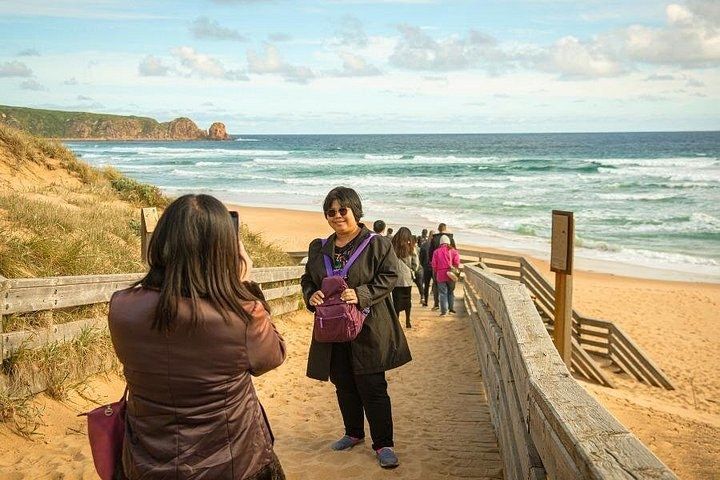
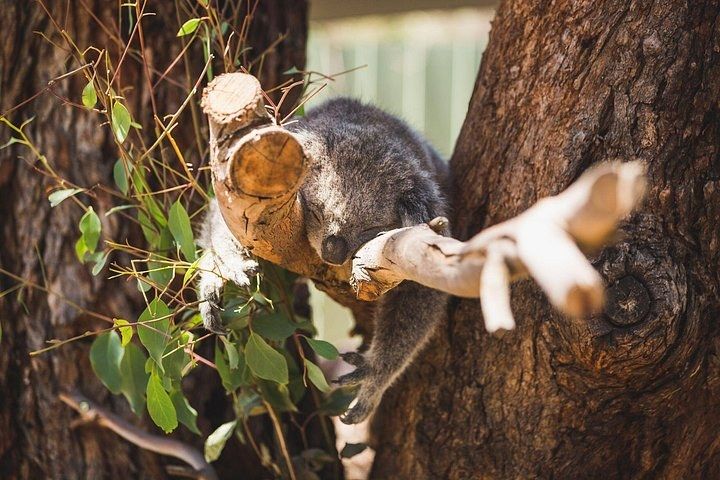
The same sandy country carries other animals, and the boardwalks before dark are a dependable place to find them. Phillip Island Nature Park runs to more than 1,805 hectares across several separate areas and is owned by the Victorian State Government, so you are standing in a working reserve.
Use that daylight hour. It is the only part of the evening when you can take a photograph, and it is when the wildlife other than penguins is actually out.
- Swamp wallabies on and beside the boardwalks
- Eastern barred bandicoots, usually as the light drops
- Cape Barren geese grazing the open ground
- Short-tailed shearwaters, back on the island from late September
The coast the colony sits on, then the crossing
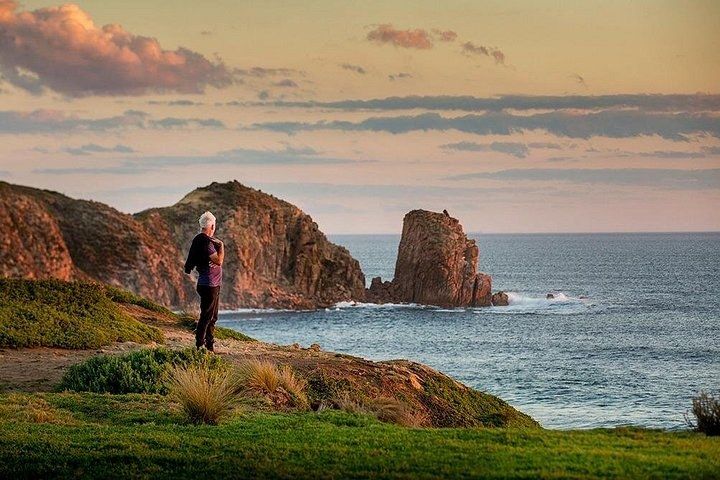
Eight hours by minivan from Melbourne, from A$246, rated 4.9 (885 reviews). It works along the coast the colony sits on, with stops at the Nobbies and Seal Rocks plus Moonlit Sanctuary, and city-centre hotel pickup and drop-off.
★ 4.9/5 · 885 reviews
What happened on the Summerland Peninsula since the 1920s
Torchlight tourism here is old. Local men were walking visitors out to the nightly arrival in the 1920s, and the first access road reached the site in late 1927. That same year the land over the burrows was carved into 776 building blocks as the Summerland Estate, and 190 houses ended up on it.
Undoing that took decades. Formal protection over the burrow ground arrived first, as a government reserve declared in 1955 by what was then the Department of Fisheries and Wildlife. The 1985 Penguin Protection Plan began buying the estate back, the Victorian Government completed the purchase by June 2010, the last houses came away and a three-year, A$3.4 million habitat restoration program followed. Foxes went the same way, through a twenty-year eradication effort that ended with the island declared fox-free in 2017.
Then the tourism buildings went. Demolishing the old visitor centre and its coach park returned more than six hectares of penguin habitat, estimated to make room for 1,400 more breeding penguins. The building that replaced it cost A$58.2 million, drew A$48.2 million from the Victorian Government's Regional Tourism Infrastructure Fund, and took its first visitors on 25 July 2019. Phillip Island Nature Parks, set up in 1996 as a self-funded conservation organisation, runs the Parade and puts visitor revenue back into research, environment and education.
| When | What happened on the site |
|---|
| 1920s | Local men begin walking tourists out by torchlight to watch the nightly arrival |
|---|
| Late 1927 | First access road built to the colony |
|---|
| 1927 | Summerland Estate cut into 776 lots over penguin ground |
|---|
| 1955 | Reserve declared over the colony by the Department of Fisheries and Wildlife |
|---|
| 1985 | Penguin Protection Plan starts the buyback of the estate |
|---|
| 1996 | Phillip Island Nature Parks established as a single organisation |
|---|
| June 2010 | Buyback completed, last houses removed, A$3.4 million restoration funded |
|---|
| 2017 | Island declared fox-free after a twenty-year eradication program |
|---|
| 25 July 2019 | Current visitor centre opens; old centre and coach park site returned to habitat |
|---|
Planning the evening around the crossing
Dusk sets the schedule, not an opening calendar. The birds land on Summerland Beach every night of the year, which leaves no closed season and no night without a crossing, and wet weather changes nothing because they come in regardless. The visitor centre opens at midday, 2pm on Christmas Day, so the whole visit is an afternoon and an evening.
An hour ahead of the estimated arrival is the lead time Nature Parks sets for General Viewing, Penguins Plus and Penguins Premium holders; Underground Viewing needs 30 minutes. Spend that hour on the boardwalks, not in the car park. Pack warm layers, a raincoat if rain looks likely and a rug for the seats, and carry a contactless card, since the venue takes no cash.
The return leg catches people out. Nature Parks puts the drive at about 90 minutes from Melbourne to the island, plus another 20 minutes past the San Remo bridge to the Parade; you cover that twice in a day and the second time in the dark, when wildlife including penguins crosses island roads, and nothing public runs back to Melbourne once the crossing is over. A round-trip tour from Melbourne handles both legs.
Questions people ask
Do the penguins come ashore anywhere else on Phillip Island?
Not any more in numbers you can visit. Nine of the island's ten original little penguin colonies have gone and the Summerland Peninsula holds the survivor, so the nightly crossing happens at Summerland Beach and there is one viewing site at the western end rather than several.
Can I see the burrows themselves?
The burrows sit in the vegetated ground behind the beach, along the boardwalks, and daylight before the crossing is the time to look at that habitat. Burrow and boardwalk upgrade works are under way at the Parade; they do not affect the arrival, but they can change which paths are open on your night.
Why is photography banned once the penguins arrive?
Because the birds depend on low light, and their eyes are sensitive enough that an unexpected flash or beam can scare and disorientate them part-way up the sand. The rule at the Parade is no cameras, camcorders or phone cameras from sunset onwards, which takes in every bird that lands. Plan for no pictures of the parade and use the hour of daylight beforehand.
What happens if it rains or blows?
It goes ahead. The penguins come ashore whatever the weather, so the parade is not cancelled for rain, and the stands are open to the sky on a south-facing coast. Dress for sitting still outdoors after dark: warm clothes, a raincoat if rain looks likely and a rug for the grandstand seats, which is what Nature Parks itself advises.
Is the colony growing or shrinking?
Growing. The Summerland Peninsula colony is estimated at about 40,000 breeding little penguins, up from about 12,000 recorded by monitoring in the mid-1980s. Removing the housing estate, eradicating foxes and restoring the ground behind the beach are the changes that sit behind that figure.
Read also